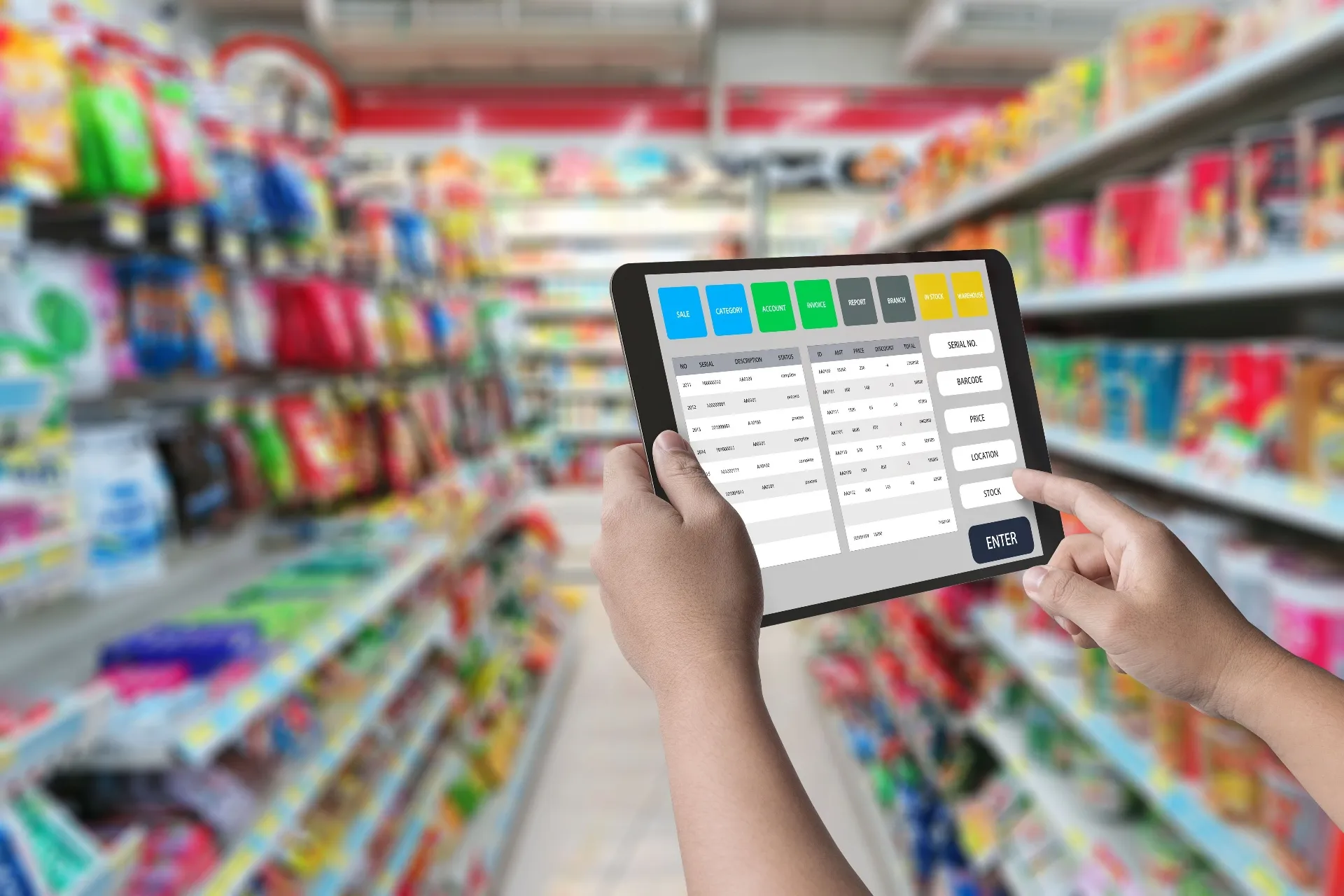
Modernise your EPOS, stock management, and omnichannel retail systems so every location, website, and sales channel works from the same real-time data.
Retail systems rarely fail all at once. They usually become harder to manage over time as new stores, sales channels, payment methods, promotions, and customer expectations are added around older technology. These are the systems we commonly modernise in retail.
POS / EPOS systems
Legacy till software running on ageing hardware, often with proprietary databases and limited integration options.
Sales reporting, footfall analysis, basket analysis, sell-through rates, and manual data exports.
Barcode & product data management
EAN and GS1 data, product information, imagery, labelling, and catalogue consistency.
Integration layers
Connections between POS, e-commerce, stock, accounts, logistics, and reporting tools. The common issue is not that each system is useless — it's that the whole operation has outgrown the way those systems connect.
Does any of this sound familiar?.
The system still takes payments and ships orders well enough to avoid replacement, though every year it becomes harder to change, harder to trust, and more expensive to support.
Issue 01
Stock is unclear across locations
The till says one number. The warehouse says another. The website still shows an item as available even though it sold yesterday. Stock accuracy depends on physical counts, and by the time one location has been counted, another has already changed. This creates overselling, missed sales, unnecessary transfers, and poor replenishment decisions.
Issue 02
Online and in-store are two separate businesses
Your website runs on one system. Your stores run on another. A customer buys online and wants to return in-store, but the store cannot see the transaction. Click-and-collect is either unavailable or held together with spreadsheets, phone calls, and manual stock checks.
Issue 03
POS is end-of-life with no upgrade path
The EPOS system has not been updated in years. The vendor may have stopped supporting it, or the original developer may no longer be available. You are left with ageing tills, fragile integrations, and expensive changes for basic retail requirements such as contactless payments, digital receipts, loyalty integration, or mobile POS.
Issue 04
Lightspeed, Vend, or Shopify POS don't fit
Off-the-shelf retail platforms can work well for simple operations. But if your pricing rules, loyalty logic, stock allocation, or product structures are specific to your business, the system starts to dictate the workflow. You pay for a platform, then rebuild your spreadsheets around it.
Issue 05
Customer data is fragmented across channels
Online customers sit in one database. In-store customers sit in another. Loyalty activity is not consistent across channels. This prevents you from seeing the full customer relationship: what people buy, where they buy, how often they return, and which promotions actually influence behaviour.
Issue 06
Reporting takes days and nobody trusts the numbers
Sales reports require exports from several systems. Someone manually combines the data, checks the totals, and reconciles the differences. By the time the report is ready, the numbers are already out of date. You cannot confidently see what is selling, where stock is moving, or which stores need attention.
How we modernise retail systems.
We start by reviewing your current systems, data, and workflows. Product data, sales history, pricing rules, supplier records, and customer information are identified and mapped before any changes are made.
If the system can be improved safely, we modernise it in stages: stock, POS, e-commerce, reporting, or another priority area. Your team continues trading while each part is tested against real store operations.
A retail system shaped around how you actually work.
The scope is broad enough to show how risk accumulates across systems, infrastructure, and day-to-day operating practices.
Real-time inventory across every location
Live stock levels for each product across stores, warehouses, and online channels. Replenishment can be triggered automatically based on sell-through rates. Stock adjustments, shrinkage, and valuation become easier to track because changes are visible and auditable.
Modern POS with omnichannel built in
Your POS can run on modern hardware, including tablets, touchscreens, and mobile devices. Click-and-collect, ship-from-store, reserve-in-store, contactless payments, chip and PIN, and digital wallet payments are built into the operational flow rather than added as workarounds.
Unified customer view
Customer profiles combine online and in-store purchase history, preferences, loyalty points, and engagement data. This gives you a more accurate basis for segmentation, retention, targeted promotions, and customer service.
Seamless e-commerce integration
Your website and store systems share stock, pricing, promotions, orders, and customer data in real time. Returns can be accepted across channels without manual checks. Marketplace connections such as Amazon and eBay can also be integrated into the same operational view.
Real-time reporting and analytics
Live dashboards by store, channel, product, category, and time period. Sales performance, basket analysis, footfall-to-conversion, sell-through rates, and replenishment signals become visible without manual exports or end-of-day reconciliation.
A stable technical foundation
Every modernised system includes internationalisation support, responsive design, CI/CD pipeline, authentication, test data framework, and a demo environment — a foundation that can keep changing as your channels, stores, and customer expectations change.
Can you modernise our systems without shutting the stores?
In most cases, yes. We can roll out changes store by store and run old and new systems in parallel during transition. If a switchover is needed for a specific location, it is planned around your trading calendar.
Our product catalogue has thousands of SKUs with complex pricing. Can you migrate all of it?
Yes. We migrate product data, pricing tiers, promotions, supplier costs, imagery, markdown rules, multi-buy logic, and loyalty discounts systematically.
We've looked at Lightspeed, Vend, or Shopify POS. How is this different?
Those platforms serve a broad market. If they fit your operation, they may be a good option. If your stock logic, pricing rules, loyalty programme, or store workflows are specific, a modernised bespoke system can fit better and cost less to adapt over time.
Can you integrate with our existing e-commerce platform?
Yes. We can connect Shopify, WooCommerce, Magento, or a bespoke web shop so stock, pricing, orders, and customer data sync automatically.
How long does a typical retail modernisation project take?
A single module, such as POS or inventory, usually takes 2–4 months. A broader project covering POS, inventory, e-commerce integration, and customer management usually takes 4–8 months. You should see working software within the first few weeks.
How much does it cost?
Typical retail modernisation projects range from £30K–£140K depending on the number of stores, channels, integrations, and operational complexity. This is often more practical than paying ongoing per-till, per-location, and per-channel licensing costs for a platform that still needs heavy adaptation.
What about Black Friday, Christmas, or peak trading periods?
Major changes are planned around your trading calendar. We do not schedule critical switchovers during your busiest periods. You should not be learning a new till system on Black Friday.
Other industries we work with
Click any tile to take a closer look at the sectors we modernise.
Your till system has been ringing up sales for years. Let's make sure it's ready for what comes next.
Book a free 30-minute discovery call. We'll discuss your retail systems, your operational pain points, and what a realistic modernisation path could look like — whether that means incremental modernisation or a fresh build.