
For a business leader running a company on systems built five, ten or fifteen years ago, technical debt is the invisible weight slowing everything down.
Most guides on this topic are written for developers. This one is for you: the person who signs off budgets, hires teams and needs technology to keep pace with what the business demands. If your software feels sluggish, your IT costs keep climbing, or your team dreads every update, technical debt is likely the reason.
Technical Debt, Without the Jargon
Think of technical debt the way you would think of deferred maintenance on a building. A landlord who skips roof repairs for three years saves money each quarter. Then one winter the ceiling collapses, and the repair bill dwarfs what prevention would have cost. Software works the same way.
You might hear it called tech debt, code debt, or technology debt. The terms are interchangeable. The concept was coined by programmerWard Cunningham in 1992. He compared quick-and-dirty code to borrowing money: you get something now, but you pay interest on it until you settle the principal. The "interest" is every hour your team spends working around old problems instead of building new features.
Here is a concrete example. A mid-sized logistics company runs its dispatch scheduling on a custom application built in 2011. The system works, but it was designed for 30 drivers and now manages 200. Every time the operations team needs a new report, it takes the developer two weeks instead of two days, because the original database structure cannot handle the current volume without manual workarounds. That gap between what the system was built to do and what the business needs it to do is technical debt.
Where Does Technical Debt Come From?
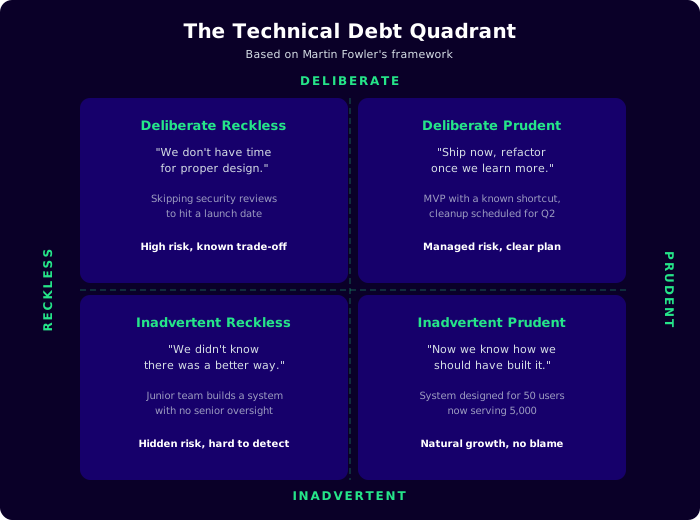
Technical debt accumulates for many reasons, and not all of them are mistakes. Some debt is deliberate, some accidental.
Deliberate debt happens when a team knowingly takes a shortcut to hit a deadline. A startup launching a product might skip building a proper user authentication system and use a basic one instead, planning to replace it later. That is a conscious trade-off: speed now, cleanup later.
Accidental debt creeps in when the team does its best work with the information available, but requirements change. A system designed for 50 users starts serving 5,000. The code was fine for its original purpose; it simply was not built for what came next. In software development and agile teams, this kind of tech debt is often the hardest to spot because nobody made a bad decision at the time.
There are also external causes. Programming languages fall out of support. Third-party vendors discontinue products. Regulations change, and systems that were compliant last year no longer meet the standard. A payroll system built before Making Tax Digital, for instance, may require significant rework to meet HMRC's current requirements.
Neglect is another common source. When businesses cut IT budgets during lean years, maintenance gets deferred. Security patches go unapplied. Small issues stack up into large ones. By the time someone looks closely, the debt has compounded well beyond what a quick fix can resolve.
A fourth type is what Martin Fowler calls "reckless and inadvertent" debt: the team does not know enough to realise it is making poor decisions. This is common when a company outgrows its original developer or hires junior engineers without senior oversight. The code works, but it is structured in ways that make future changes expensive.
Why Should Business Leaders Care?
Technical debt has a direct impact on your bottom line, even when it is invisible on the balance sheet.
The first cost is speed. According to the Stripe Developer Coefficient report, developers spend an estimated 33% of their time dealing with technical debt and maintenance, with global productivity losses estimated at $300 billion a year. For a team of ten, that is more than three full-time salaries spent on keeping old systems running rather than building anything new. Every feature request, every integration with a new partner, every regulatory update takes longer and costs more than it should.
McKinsey puts the scale even higher: companies spend up to 40% of their IT budgets servicing legacy systems, and Gartner reports that 93% of teams acknowledge carrying technical debt, with up to 40% in additional maintenance costs for those who do not address it.
The second cost is risk. Outdated systems are more vulnerable to security breaches. The UK's National Cyber Security Centre regularly warns that end-of-life software, meaning software no longer receiving security updates, is one of the most common attack vectors for small and medium businesses. A data breach carries financial penalties under UK GDPR, reputational damage, and operational disruption.
The third cost is talent. Good developers do not want to spend their careers maintaining brittle, outdated code. If your systems are painful to work with, your best people leave, and replacing them is expensive. A 2023 Stack Overflow survey found that legacy systems and technical debt were among the top frustrations driving developer attrition, with 62% of developers naming technical debt as a major problem.
The fourth cost is missed opportunity. When your technology cannot keep up, you lose deals. A competitor with modern systems can onboard a new client in days; if yours takes weeks because of manual processes and system limitations, the client goes elsewhere.
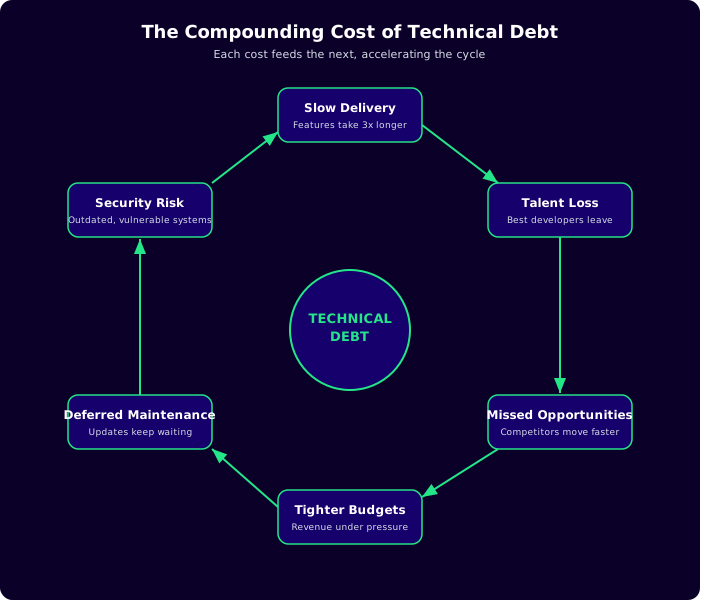
There is also a compounding effect. Each of these costs feeds into the others. Slow systems frustrate good developers, who leave; their departure means fewer people who understand the code debt, which makes changes even slower; slower delivery means missed opportunities, which reduces revenue, which tightens budgets, which delays the maintenance that would have fixed things. The cycle accelerates unless someone intervenes. For a finance-led breakdown of how these compounding costs show up on the books, see the true cost of a legacy system.
How to Spot Technical Debt in Your Organisation
You do not need to read code to recognise technical debt. These are the warning signs visible from the boardroom:
- Simple changes take a long time. A request that sounds straightforward, like adding a new field to a report, takes weeks instead of days.
- The same things keep breaking. Your team fixes a problem in one area, and something unrelated breaks. This is a sign that the system's components are tangled together in ways they should not be.
- Your developers avoid certain parts of the system. If there are modules or features that nobody wants to touch, it is because the code there is fragile and poorly structured.
- You rely on one person who "knows how it works." When institutional knowledge lives in a single developer's head because the system is too convoluted for anyone else to understand, you have a serious concentration risk.
- Integration with new tools is painful. Connecting your system to a modern API, a new payment provider, or a cloud service requires custom workarounds every time.
- Your IT costs keep rising without visible improvement. You are spending more each year on maintenance, hosting, or emergency fixes, yet the system does not feel any better.
- You are running software that is no longer supported by its vendor. If you are on Windows Server 2012, PHP 5, or any platform past its end-of-life date, you are carrying debt that comes with active security risk.
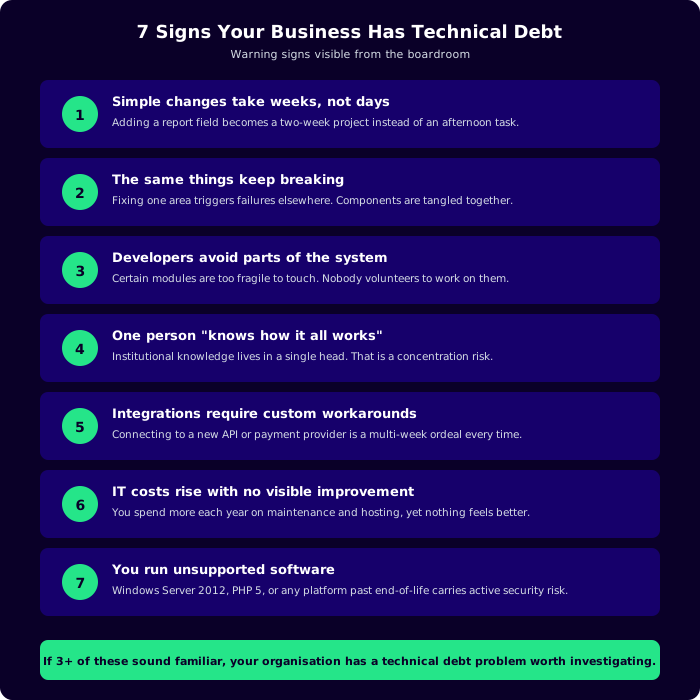
If three or more of these sound familiar, your organisation has a technical debt problem worth investigating.
What You Can Do About It
Recognising the problem is a good start. The next step is deciding what to do, and the honest answer is that there is no single right approach. The best path depends on your systems, your budget, and how urgently the business needs to change.
Assess and Prioritise
Start by understanding what you have. Commission a technical assessment, either from your internal team or an external specialist, that maps your systems, identifies the biggest risks, and estimates the cost of inaction.
Prioritise based on business impact. A legacy system that processes payments and handles customer data carries more risk than an internal tool used by three people. Fix the high-risk, high-impact problems first.
A useful framing: ask your technical team to categorise debt into three buckets. The first bucket is debt that poses an active risk (security vulnerabilities, compliance gaps). The second is debt that slows the business down measurably (features that cannot be delivered, integrations that fail). The third is debt that is annoying but tolerable for now. Tackle them in that order.
Incremental Modernisation vs. Full Rebuild
The question of whether to modernise gradually or rebuild from scratch comes up in every legacy conversation. Both approaches have merit, and the right choice depends on the situation.
Incremental modernisation works well when the core system is sound but surrounded by outdated components. You replace pieces one at a time: move the database to a modern platform, update the user interface, swap out deprecated libraries. The business keeps running throughout, and each step delivers measurable improvement. For most SMBs, this is the lower-risk option.
A full rebuild makes sense when the existing system is so far gone that patching it costs more than starting over. If the architecture cannot support the business's direction, if the programming language is effectively dead, or if the original vendor has disappeared, rebuilding may be the more economical choice over a three-to-five year horizon. It is more expensive upfront and carries more risk during the transition, so it requires careful planning.
Many organisations end up with a blend: rebuild the most critical component, modernise the rest incrementally, and retire what is no longer needed. There is no shame in a pragmatic approach.
How to Measure Technical Debt
Before you commit resources, you need a rough sense of scale. There are several ways to measure technology debt, and none of them require you to understand the code yourself.
The simplest metric is the ratio of maintenance to new work. Ask your development team what percentage of their time goes toward keeping existing systems running versus building new capabilities. If the answer is above 40%, you have a problem that is costing real money.
Another approach is to track the time from request to delivery. If adding a simple feature to a modern part of your system takes two days but a comparable change to the legacy part takes three weeks, the difference tells you where the debt is concentrated. You can also look at incident frequency: how often things break, how long it takes to fix them, and which systems are involved. Patterns emerge quickly.
Your finance team can help too. Compare your annual IT spend against your competitors of similar size. If you are spending significantly more with less to show for it, a good portion of that gap is likely going to debt servicing, not value creation.
How to Reduce and Prevent Future Technical Debt
Paying down existing debt is only half the work. You also need processes that stop new debt from piling up.
Set aside a fixed percentage of each development cycle for debt reduction. Many successful engineering teams reserve 20% of their capacity for maintenance and cleanup work. This is not wasted time; it is the equivalent of servicing a loan so the interest does not spiral.
Build quality checkpoints into your procurement process. When commissioning new software or hiring a development partner, ask about their approach to code quality, testing, and documentation. A project delivered quickly but poorly documented will generate debt from day one.
Review your technology stack annually. A brief audit, even an informal one, catches problems while they are still small. A framework that was current two years ago may already be approaching end-of-life. Catching that early gives you time to plan a migration instead of scrambling when support ends.
Invest in documentation. When system knowledge lives only in people's heads, every departure is a crisis. Written documentation, architecture diagrams, and clear onboarding materials reduce your dependence on any single person and make future maintenance cheaper.
Get Expert Help Early
Technical debt decisions involve real money and real risk. If you do not have deep technical expertise on your leadership team, bring in someone who does, before you commit to a direction.
An independent assessment gives you a clear picture of where you stand, what your options are, and what each path will cost. It also protects you from vendor lock-in; a consultant with no product to sell will give you straighter answers than a software vendor pitching a migration to their platform.
Key Takeaways
Technical debt is the accumulated cost of shortcuts, outdated technology and deferred maintenance in your software systems. It affects your speed, your security, your ability to hire, and your capacity to compete.
You can spot it without reading a line of code: look for slow delivery, recurring breakdowns, rising IT costs, and systems that depend on a single person's knowledge.
The fix is not always a complete rebuild. Assess first, prioritise by business impact, and choose an approach that matches your budget and timeline. Prevent new debt by reserving development capacity for maintenance and reviewing your stack regularly.
Leaving technical debt unaddressed does not make it go away. It makes it more expensive. The earlier you understand what you are dealing with, the more options you have.
Sources & Further Reading
- Agile Alliance — Introduction to the Technical Debt Concept (origin of Ward Cunningham's metaphor, OOPSLA 1992).
- Wikipedia — Technical Debt.
- Martin Fowler — Technical Debt.
- Martin Fowler — Technical Debt Quadrant (deliberate/inadvertent × reckless/prudent).
- Stripe — The Developer Coefficient (2018).
- McKinsey — Tech Debt: Reclaiming Tech Equity.
- McKinsey — Demystifying Digital Dark Matter.
- Gartner — Reduce and Manage Technical Debt.
- NCSC — Obsolete Products Guidance.
- NCSC — Advice for Small & Medium Organisations.
- Stack Overflow Developer Survey 2023.