The bottleneck has moved
A recent industry survey found that 85% of DevSecOps professionals agree AI has shifted the bottleneck in software development from writing code to reviewing and validating it. That shift matters more in legacy modernisation than almost anywhere else in software engineering.
Writing a converted version of a decades-old COBOL routine is no longer the hard part. The hard part is knowing whether that conversion preserved the original business logic. It's also knowing whether the change introduced a regression nobody spots until month-end processing, and whether it can be explained to an auditor six months later.
What AI tools genuinely do well
Credit where it's due. One consulting firm reported that a legacy modernisation programme originally projected to take nine months with fourteen engineers was completed in three days after introducing an AI coding platform to the project. That's a real result.
Tools built for legacy languages read RPG or COBOL syntax that most developers today have never been trained on. They generate documentation for systems whose original documentation disappeared years ago. For a genuine skills gap in an ageing codebase, that's a real advantage, and it's one reason we bring AI-assisted tooling into our own modernisation work rather than avoiding it.
Why speed alone doesn't make modernisation predictable
A fast conversion tool answers one question well: how quickly can this code be rewritten. It doesn't answer which system to migrate first, or what breaks elsewhere if a dependency between two legacy modules is missed. It also doesn't answer whether the sequence of changes can be justified to a regulator or an investor doing due diligence ahead of an acquisition.
Speed without oversight carries its own cost too. Security researchers found that earlier versions of a comparable AI coding platform could be manipulated through the command line into executing malicious code, and that its IDE was vulnerable to common AI-specific data exfiltration methods. A tool that moves fast and a modernisation programme that moves safely aren't automatically the same thing.
This is where most legacy projects come apart, in the gap between a coding tool and a coordinated plan. Closing that gap is what actually makes an outcome predictable, and it's the part of the work most vendors leave to the client.
A single process, from assessment through to delivery
Take a mid-market financial services firm migrating its core ledger system off an ageing platform. The coding work, converting routines, rewriting interfaces, regenerating tests, can move quickly with the right tool. Before any of that starts, someone needs to map dependencies against three other modules and sequence the migration around month-end reconciliation.
Someone also needs to define who signs off that the audit trail survives the move.
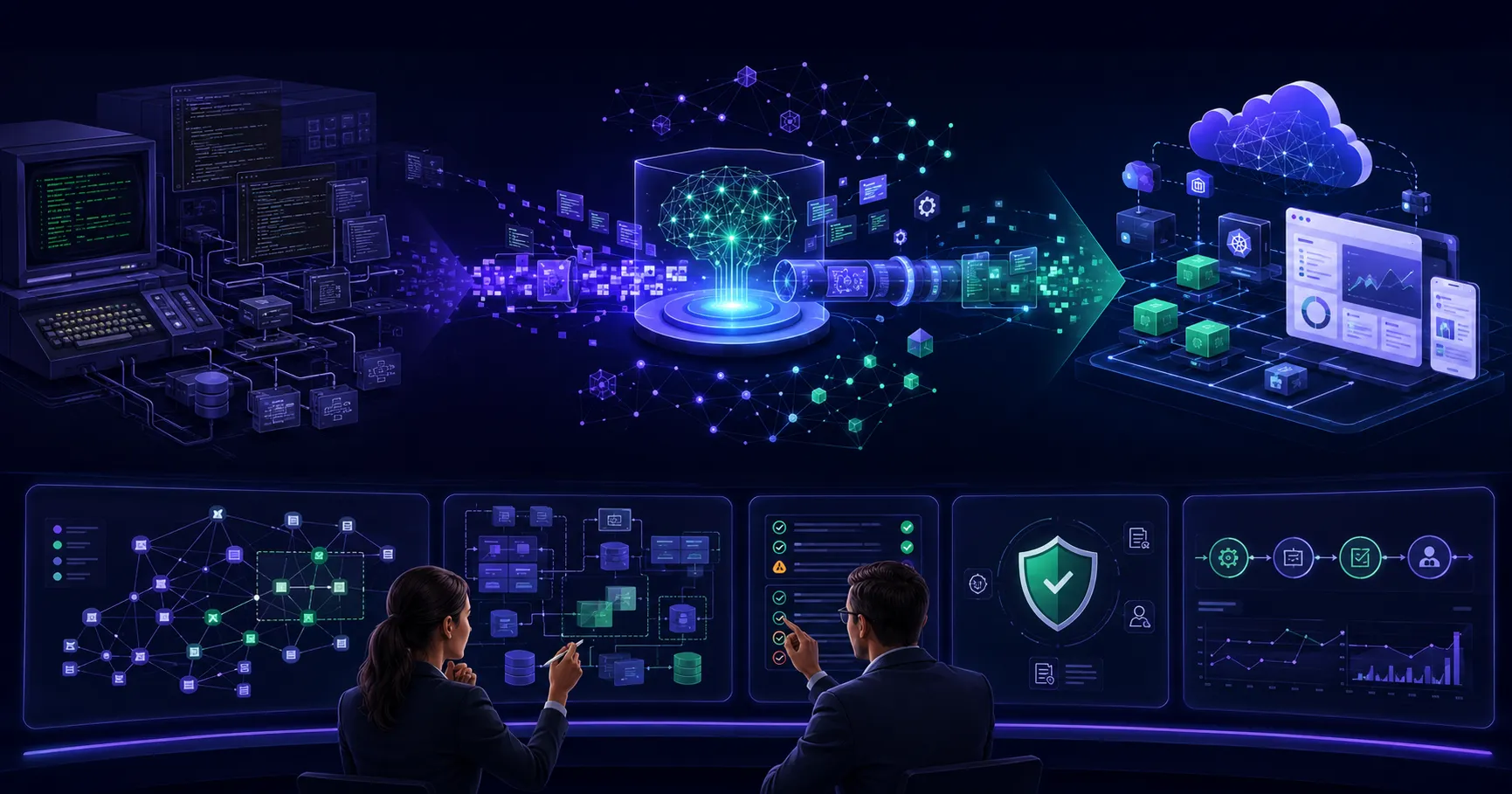
At Hollinford, we run assessment, sequencing and delivery as one process rather than three separate handoffs. The same team that maps the risk also carries the migration through to production, using AI-assisted tooling where it genuinely speeds things up, and human review where the stakes call for it. That continuity, not the coding speed on its own, is what makes the outcome predictable.
Where this leaves you
AI tools have made the coding side of modernisation faster than it's ever been. That's a real shift, and worth using well. Predictability, though, comes from how assessment, sequencing and execution are held together, not from how fast any one step runs.
This is exactly what we cover in Hollinford's September webinar on legacy system risk assessment: how we turn that assessment into a full modernisation plan we carry through to delivery, not a report handed off for someone else to execute. Details and registration are on the webinar page.